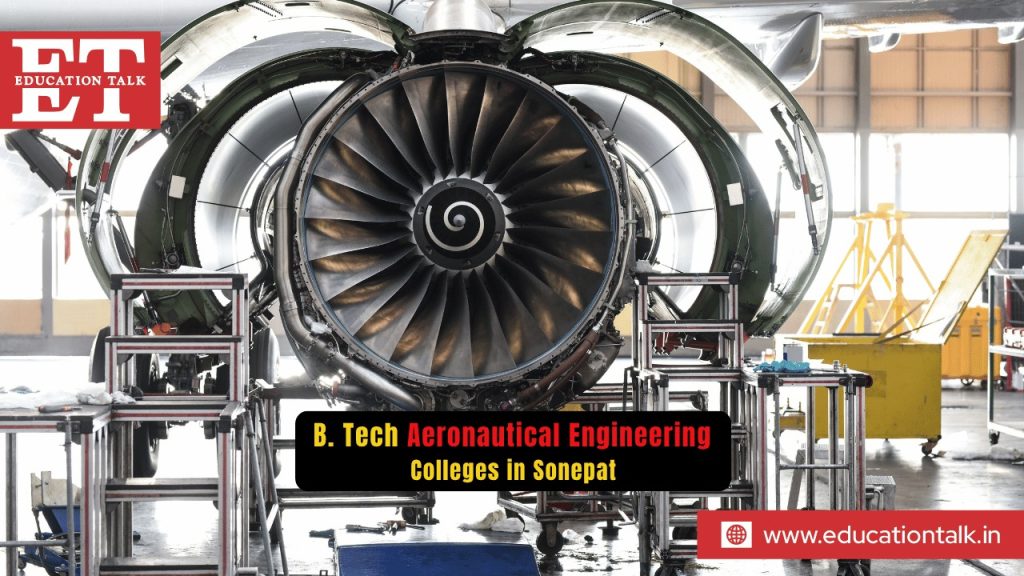
B.Tech Aeronautical Engineering Colleges in Sonepat
Posted on : 9 October, 2026 2:25 am
Choosing an engineering branch is a major career decision. For students who are fascinated by aircraft, aviation technology, defence systems, drones and high-performance machines, B.Tech Aeronautical Engineering can offer a specialised route into a technically demanding field.
For students searching for B Tech Aeronautical Engineering Colleges in Sonepat, the decision should go beyond simply finding a college that offers the course. You should compare the curriculum, practical laboratories, faculty, admission route, industry exposure, internship opportunities, placement support and long-term career options.
Sonepat, also written as Sonipat, is particularly relevant for students from Delhi NCR and Haryana because of its location, engineering education ecosystem and access to the wider NCR industrial and aviation environment.
India’s aviation sector is also entering an important phase. At Wings India 2026, the Government of India highlighted India’s position as the world’s third-largest domestic aviation market and pointed to opportunities in aircraft manufacturing, advanced air mobility, aircraft leasing and related sectors.
That creates an important opportunity for students—but choosing the right engineering programme remains essential.
What Is B.Tech Aeronautical Engineering?
B.Tech Aeronautical Engineering is a four-year undergraduate engineering programme focused primarily on the design, development, analysis, testing and manufacturing of aircraft and related systems operating within the Earth’s atmosphere.
Students generally study areas such as:
- Aerodynamics
- Aircraft Structures
- Propulsion
- Flight Mechanics
- Aircraft Performance
- Aircraft Systems and Instrumentation
- Thermodynamics
- Fluid Mechanics
- Aircraft Materials
- Stability and Control
- Computational Fluid Dynamics
- CAD and engineering design
- Avionics and aircraft electronics
The objective is not simply to learn how an aircraft flies. Students also develop the mathematical, analytical, design and engineering skills needed to understand how aircraft systems are designed, tested and improved.
Aeronautical Engineering vs Aerospace Engineering
These terms are closely related but are not identical.
| Feature | Aeronautical Engineering | Aerospace Engineering |
|---|---|---|
| Main focus | Aircraft | Aircraft and spacecraft |
| Operating environment | Mainly within Earth’s atmosphere | Atmosphere and space |
| Key areas | Aerodynamics, propulsion, structures | Aerodynamics, propulsion, spacecraft systems |
| Careers | Aircraft design, aviation, defence, manufacturing | Aerospace, space, defence, UAVs and research |
| Suitable for | Students interested primarily in aviation and aircraft | Students wanting broader aerospace opportunities |
Therefore, students should read the actual course curriculum rather than selecting a programme based only on the word “aerospace” or “aeronautical” in its name.
Top B.Tech Aeronautical and Aerospace Engineering Options in and Around Sonepat
1. Deenbandhu Chhotu Ram University of Science and Technology (DCRUST), Murthal
DCRUST is a public university in Murthal, Sonepat, and is an important government engineering option for students in the region.
Its current academic/examination information includes B.Tech Aeronautical Engineering and B.Tech Aerospace Engineering, making it particularly relevant to students searching for aeronautical engineering in Sonipat.
Students considering DCRUST should check the latest official admission notification, eligibility requirements, seat matrix and counselling process before applying.
2. National Institute of Technology Delhi
NIT Delhi is another government-funded engineering institution within the broader NCR region. Its current undergraduate programmes include B.Tech Aerospace Engineering. The institute’s Department of Mechanical and Aerospace Engineering supports the programme, while its curriculum includes dedicated Aerospace Engineering coursework.
For students who are open to Aerospace Engineering rather than only Aeronautical Engineering, NIT Delhi is therefore a relevant option to investigate.
3. Puran Murti Vidyapeeth, Sonepat
Puran Murti Vidyapeeth, offer B.Tech Aeronautical Engineering for students who want to develop a strong foundation in aircraft design, aerodynamics, propulsion, structures, flight mechanics and related engineering disciplines.
They also provides related pathways, including B.Tech Aerospace Engineering and integrated programmes involving Aeronautical Engineering and AME/DGCA-related training.
Their B.Tech programme is designed as a four-year engineering degree, with classroom learning supported by laboratory and practical training. Their academic structure includes aerodynamics, propulsion, aircraft structures, aircraft performance, stability and control, CFD and project-based learning.
Why Study Aeronautical Engineering in Sonepat?
Sonepat offers a practical location for students who want to remain connected to the Delhi NCR education and employment ecosystem while studying in Haryana.
Key advantages include:
- Delhi NCR connectivity – Students can access the wider NCR ecosystem for education, internships, events and career opportunities.
- Engineering education ecosystem – Sonepat and nearby Murthal have multiple engineering institutions.
- Growing aviation sector – India’s aviation market is expanding, while aircraft manufacturing and related capabilities are receiving increased policy attention.
- Specialised engineering education – Students can explore aeronautical, aerospace, mechanical, electronics and related technical disciplines.
- Career flexibility – Graduates can build careers across aircraft design, manufacturing, testing, defence, UAVs, MRO and higher education.
For a student from Delhi, Panipat, Rohtak, Bahadurgarh, Sonipat or other parts of NCR, location can also make campus visits and industry-oriented activities more accessible.
B.Tech Aeronautical Engineering Eligibility Criteria
For most B.Tech Aeronautical Engineering programmes, students should have completed Class 12 with Physics, Chemistry and Mathematics (PCM) from a recognised board.
Typical eligibility checklist
- Class 12 or equivalent qualification
- Physics and Mathematics as core subjects
- Chemistry or another qualifying subject as prescribed
- Required minimum aggregate according to the applicable admission rules
- Valid entrance examination score where applicable
- Required documents for counselling and verification
What about diploma students?
Students who have completed a relevant three-year engineering diploma may be able to pursue B.Tech through lateral entry, subject to the applicable university and regulatory rules.
This route can allow eligible diploma holders to enter the second year of a B.Tech programme. The exact entrance test, percentage requirement and admission procedure can vary, so students should verify the current rules before applying.
How to Get Admission to B.Tech Aeronautical Engineering in Sonepat
The admission process depends on the institution and the applicable state or university admission system.
A practical admission roadmap is:
- Complete Class 12 with PCM.
- Check the eligibility criteria of the selected colleges.
- Appear for JEE Main or another applicable entrance examination, where required.
- Check Haryana counselling/admission requirements.
- Apply through the college or authorised admission route where merit-based admission is available.
- Complete counselling and document verification.
- Compare the final academic, hostel and other applicable costs.
- Confirm the seat and complete admission formalities.
Because admission rules can change from one academic session to another, students should rely on the latest official notification rather than an old blog or social-media post.
What Do You Study in B.Tech Aeronautical Engineering?
A strong aeronautical engineering programme combines mathematics, physics, engineering science and practical application.
Core subjects students may encounter
Aerodynamics:
Students learn how air interacts with aircraft surfaces and how factors such as lift, drag and airflow influence aircraft performance.
Aircraft Structures:
This area covers the structural design and analysis of aircraft components, including materials, loads, stress and structural safety.
Aircraft Propulsion:
Students study how aircraft engines generate thrust and examine propulsion technologies and engine performance.
Flight Mechanics:
This involves aircraft motion, stability, control, performance and flight dynamics.
Computational Fluid Dynamics:
CFD introduces computational approaches for analysing fluid flow and solving engineering problems.
Avionics and Instrumentation:
Students learn about aircraft electronic systems, instrumentation, navigation, communication and control-related technologies.
Why Practical Training Matters
Aeronautical engineering is not a branch that should be studied only from textbooks.
Students need opportunities to connect engineering theory with real systems, measurements, simulations and design problems.
Our aeronautical and aerospace learning environment includes specialised facilities covering areas such as aerodynamics, propulsion, flight mechanics and materials, along with workshops and simulation tools.
Look for these facilities when comparing colleges
- Aerodynamics laboratory
- Wind-tunnel facilities
- Propulsion laboratory
- Aircraft structure laboratory
- Avionics laboratory
- CAD/CAE facilities
- Simulation tools
- Engineering workshops
- Project-development spaces
- Industry visits and internships
A useful question for parents is simple: How much of the programme allows students to apply what they learn?
That answer can reveal more about the practical value of a course than a long list of facilities.
Career Opportunities After B.Tech Aeronautical Engineering
A B.Tech in Aeronautical Engineering can lead to several technical and interdisciplinary career paths.
Popular career roles
- Aeronautical Engineer
- Aircraft Design Engineer
- Aerospace Design Engineer
- Aerodynamics Engineer
- Propulsion Engineer
- Structural Engineer
- Flight Test Engineer
- CAD/CAE Engineer
- UAV/Drone Engineer
- Manufacturing Engineer
- Quality Engineer
- Aircraft Systems Engineer
- Research and Development Engineer
Graduates may explore opportunities in:
- Aircraft manufacturing
- Aerospace companies
- Defence and defence manufacturing
- Airlines and aviation companies
- MRO organisations
- UAV and drone technology
- Engineering design companies
- Research organisations
- Government-sector opportunities
- Higher education and research
However, students should understand that a B.Tech degree alone does not guarantee a particular job, salary or government position. Career outcomes depend on technical skills, academic performance, projects, internships, communication ability, recruitment conditions and the specific eligibility requirements of employers.
B.Tech Aeronautical Engineering and the Future of Aviation in India
The long-term outlook for aviation and aerospace is an important reason students are considering this field.
The Government of India stated in 2026 that India had become the world’s third-largest domestic aviation market and highlighted aircraft manufacturing, advanced air mobility and aircraft leasing among emerging opportunities.
Government data presented to Parliament in 2025 also noted rapid airline expansion and reported that 350 aircraft had already been imported by 31 January 2025, while major airlines had placed additional aircraft orders.
These trends do not mean every aeronautical graduate will automatically get a job. Instead, they indicate why skills in aircraft systems, manufacturing, engineering design, maintenance, simulation, UAVs and related technologies are becoming increasingly relevant.
How to Choose the Best Aeronautical Engineering College in Sonepat
Do not select a college only because it appears first on a search result.
Use this checklist:
| Factor | What Students Should Check |
|---|---|
| Programme | B.Tech Aeronautical or Aerospace |
| Recognition | Applicable approvals and affiliation |
| Curriculum | Core aeronautical subjects and electives |
| Laboratories | Aerodynamics, propulsion, structures and avionics |
| Faculty | Academic qualifications and technical experience |
| Practical learning | Projects, simulations and laboratory work |
| Industry exposure | Internships, visits and workshops |
| Placement support | Training, recruitment drives and career guidance |
| Location | Connectivity with Sonipat and Delhi NCR |
| Fees | Total academic and hostel expenses |
| Student support | Hostel, library, mentoring and campus facilities |
| Higher studies | M.Tech, MS, research and related pathways |
A useful rule for parents
Instead of asking only, “Which is the best college?”, ask:
“Which college provides the right combination of programme quality, practical exposure, affordability and career preparation for my child?”
What Skills Should an Aeronautical Engineering Student Develop?
A successful aeronautical engineer needs more than marks.
Focus on developing:
- Strong mathematics and physics fundamentals
- CAD and engineering design skills
- Problem-solving ability
- Knowledge of aircraft systems
- Programming and computational skills
- CFD and simulation awareness
- Technical communication
- Teamwork and project management
- Internship experience
- Continuous learning
Students interested in drones, UAVs, robotics or advanced manufacturing can also build complementary skills because these areas increasingly overlap with aerospace engineering.
Aeronautical Engineering vs Mechanical Engineering: Which Is Better?
Neither branch is universally better.
Aeronautical Engineering is more specialised toward aircraft and aviation systems. Mechanical Engineering is broader and covers machines, manufacturing, thermal systems, design and many industrial applications.
Choose Aeronautical Engineering if you are strongly interested in aircraft, aviation, aerodynamics and aerospace systems.
Choose Mechanical Engineering if you want a broader engineering foundation with career flexibility across automotive, manufacturing, energy, design and other industries.
Your interest, aptitude and long-term career plan should drive the decision.
Top Benefits of Studying B.Tech Aeronautical Engineering
A B.Tech Aeronautical Engineering degree can provide:
- Specialised knowledge of aircraft technology
- Exposure to advanced engineering concepts
- Opportunities in aviation and aerospace
- A foundation for M.Tech/MS and research
- Scope to work in UAV and drone technologies
- Exposure to aircraft design and manufacturing
- Opportunities to develop technical and analytical skills
- A pathway into defence-related engineering careers, subject to applicable recruitment criteria
Most importantly, the degree can suit students who genuinely enjoy physics, mathematics, engineering design and aircraft technology.
Conclusion: Choose Your Aeronautical Engineering College Carefully
The search for B Tech Aeronautical Engineering Colleges in Sonepat should begin with your career goal, not just a college name.
Compare the curriculum, laboratories, faculty, admission route, practical exposure, internships, placement support, fees and opportunities for higher studies. Also consider whether you want a specialised Aeronautical Engineering degree or the broader scope of Aerospace Engineering.