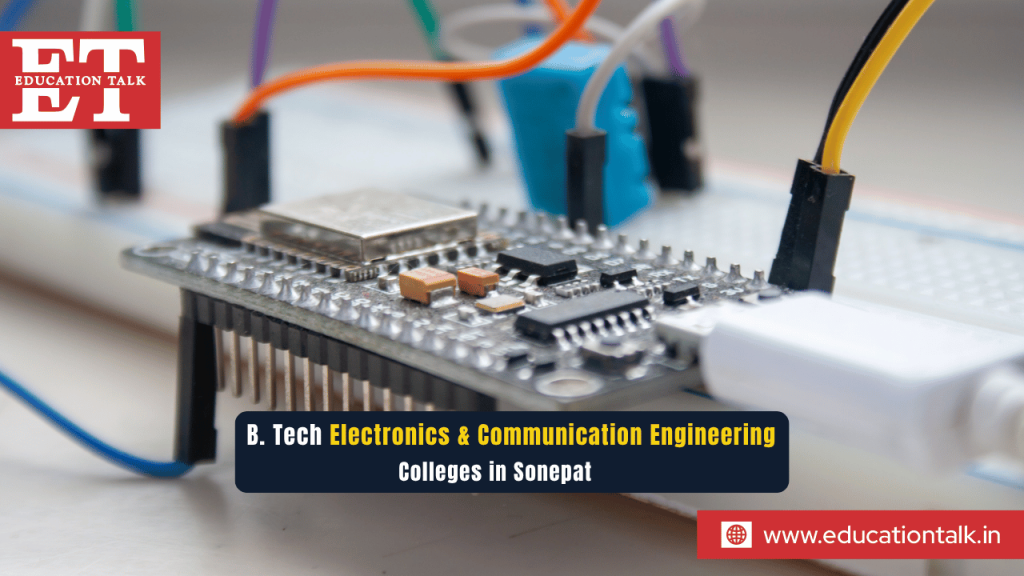
B. Tech ECE Colleges in Sonepat
Posted on : 9 October, 2026 5:37 pm
Electronics and Communication Engineering (ECE) is an important branch of engineering that connects electronic hardware, communication networks, digital systems, and modern computing technologies. From smartphones and wireless networks to satellites, smart devices, robotics, and semiconductor chips, ECE plays a significant role in the development of today’s technology.
Sonepat, also known as Sonipat, is an emerging education destination in Haryana. Its location near Delhi makes it a convenient choice for students looking for engineering colleges within the Delhi-NCR region. Students can explore different institutions based on their academic interests, admission eligibility, practical facilities, fee structure, and future career plans.
Students searching for B Tech Electronics & Communication Engineering Colleges in Sonepat can consider institutions such as Puran Murti Vidyapeeth, South Point Institute of Technology and Management, Bharat Institute of Technology, and other institutions in the surrounding region. Bhagat Phool Singh Mahila Vishwavidyalaya at Khanpur Kalan is another institution with an ECE department and undergraduate programme information.
A B.Tech in Electronics and Communication Engineering generally takes four years to complete. The programme combines theoretical learning, laboratory experiments, technical projects, and engineering applications to help students understand how electronic devices and communication systems work.
Top B Tech Electronics & Communication Engineering Colleges in Sonepat
The following institutions can be explored when comparing ECE education in Sonepat and nearby areas. Students should confirm the latest programme availability and admission conditions before applying.
| Rank | College Name | Location |
|---|---|---|
| 1 | Puran Murti Vidyapeeth | Kami, Sonepat |
| 2 | South Point Institute of Technology and Management | Sonepat |
| 3 | Bharat Institute of Technology | Sonepat |
| 4 | Bhagat Phool Singh Mahila Vishwavidyalaya | Khanpur Kalan, Sonepat |
| 5 | Deenbandhu Chhotu Ram University of Science and Technology | Murthal, Sonepat |
This is a suggested list for researching colleges, not an official ranking. Verify the current B.Tech ECE offering at each institution for your intended admission year.
1. Puran Murti Vidyapeeth
Puran Murti Vidyapeeth, located in Kami, Sonepat, is an option for students researching engineering education in the Delhi-NCR region. Students considering Electronics and Communication Engineering should review the institution’s current programme details, eligibility criteria, facilities, and admission process before applying.
ECE education focuses on electronic circuits, communication technologies, digital systems, signal processing, and embedded devices. Students need both theoretical understanding and practical skills to work confidently with electronic equipment and communication systems.
When evaluating colleges, students should examine the availability of electronics laboratories, computing resources, project opportunities, faculty guidance, and technical activities. These facilities can help students connect classroom concepts with real engineering applications.
The location in Sonepat may also suit students travelling from Delhi, Panipat, Rohtak, Bahadurgarh, and nearby parts of Haryana.
2. South Point Institute of Technology and Management
South Point Institute of Technology and Management is located in Sonepat and publishes information about its Electronics and Communication Engineering department. Its official department page describes a four-year B.Tech ECE programme and mentions practical laboratory facilities. The institute also publishes ECE syllabi for different years of study.
The department’s academic areas are relevant to students who want to understand electronics, communication systems, circuit design, and related technologies.
Practical work is particularly important in this field because students need to learn how to analyse circuits, use electronic instruments, test components, and troubleshoot technical problems. Students can check the institute’s current course structure, admission requirements, and facilities before deciding whether it meets their needs.
3. Bharat Institute of Technology, Sonepat
Bharat Institute of Technology is located in the Sonepat region. The Haryana State Technical Education Society’s 2026 B.E./B.Tech prospectus lists Electronics and Communication Engineering among the branches associated with the institute.
Students considering this institution should confirm the latest approved intake, course availability, eligibility requirements, and admission procedure for their intended academic session.
When comparing engineering colleges, it is useful to examine laboratory access, the curriculum, faculty support, project work, internship opportunities, transportation, and total education costs. These factors can help students make an informed decision rather than relying only on a college’s name or location.
4. Bhagat Phool Singh Mahila Vishwavidyalaya
Bhagat Phool Singh Mahila Vishwavidyalaya (BPSMV) is situated in Khanpur Kalan, Sonepat. The university has an Electronics and Communication Engineering department under its Faculty of Engineering and Technology.
Its published programme information describes B.Tech ECE education and laboratory facilities related to electronic devices and circuits, digital circuits, communication, digital signal processing, PCB design, and circuit simulation.
The university’s engineering environment may be relevant for students seeking information about ECE education in the Sonepat district. Prospective applicants should review the current prospectus to confirm programme availability, eligibility, intake, and admission requirements.
5. Deenbandhu Chhotu Ram University of Science and Technology
Deenbandhu Chhotu Ram University of Science and Technology (DCRUST) is located at Murthal in the Sonepat district. It is an established technical university in Haryana and offers education across engineering and other disciplines.
Students interested in studying near Sonepat can explore the university’s current engineering programmes and departmental information. However, applicants should specifically confirm whether the B.Tech Electronics and Communication Engineering programme is available for their chosen admission year before including it in their final shortlist.
A comparison of curriculum, practical facilities, faculty, fees, and career support can help students decide which institution is suitable for their academic goals.
What Is B.Tech Electronics and Communication Engineering?
B.Tech Electronics and Communication Engineering is an undergraduate engineering programme that focuses on the design, development, analysis, and application of electronic devices and communication systems.
Electronics deals with components and circuits that process electrical signals. Communication engineering focuses on transmitting information between devices and systems through wired or wireless channels.
The two areas work together in mobile phones, satellite systems, networking equipment, medical electronics, smart appliances, industrial automation, and many other technologies.
During the course, students learn how electronic components function, how signals are processed, how information is transmitted, and how digital systems are designed. They also develop problem-solving, mathematical, analytical, and technical skills.
Important Subjects in ECE
The exact syllabus depends on the university, but a B.Tech ECE programme commonly includes the following subjects:
- Engineering Mathematics
- Electronic Devices and Circuits
- Analog Electronics
- Digital Electronics
- Signals and Systems
- Communication Systems
- Digital Communication
- Microprocessors and Microcontrollers
- Embedded Systems
- Electromagnetic Theory
- Antenna and Wave Propagation
- Digital Signal Processing
- Computer Networks
- VLSI Design
- Control Systems
- Internet of Things
- Engineering Physics
- Programming Fundamentals
Laboratory sessions complement these subjects. Students may perform circuit experiments, analyse signals, program microcontrollers, simulate electronic systems, and complete technical projects.
Eligibility for B.Tech ECE
Eligibility criteria vary by college and admission authority. Generally, students seeking admission to B.Tech ECE should complete Class 12 with Physics and Mathematics, along with the additional subject requirements specified by the institution.
Candidates may also need to meet minimum qualifying marks and satisfy entrance examination or counselling requirements.
A typical admission process may include:
- Completing Class 12 with the required subjects.
- Checking the current eligibility criteria.
- Appearing for the applicable entrance examination, if required.
- Participating in counselling or applying through the institution’s admission process.
- Submitting academic and identity documents.
- Completing document verification.
- Paying the applicable admission fees.
Students should consult the latest official admission brochure because entrance requirements, seat availability, and admission procedures can change between academic years.
Why Practical Learning Matters in ECE
Electronics and communication systems are best understood through a combination of theory and experimentation. Practical training helps students learn how electronic components behave and how complete systems operate.
Useful practical activities can include:
- Building and testing electronic circuits
- Measuring voltage, current, and signals
- Working with digital logic circuits
- Programming microcontrollers
- Developing embedded-system projects
- Simulating electronic circuits
- Studying wireless communication
- Designing printed circuit boards
- Troubleshooting electronic equipment
Projects also encourage teamwork, planning, documentation, and problem-solving. Students should look for colleges that provide opportunities to practise these skills alongside regular classroom learning.
Career Opportunities After B.Tech ECE
ECE graduates can explore careers in electronics, telecommunications, embedded systems, networking, semiconductor technology, automation, and software-related industries.
Possible job roles include:
- Electronics Engineer
- Communication Engineer
- Embedded Systems Engineer
- Telecom Engineer
- Hardware Design Engineer
- Network Engineer
- VLSI Design Engineer
- PCB Design Engineer
- Testing and Validation Engineer
- IoT Engineer
- Signal Processing Engineer
- Technical Support Engineer
- Semiconductor Engineer
- Software Engineer
The available roles depend on a graduate’s technical skills, specialisation, internships, experience, and employer requirements.
Students can also prepare for government recruitment examinations or continue their education through postgraduate programmes in areas such as VLSI, embedded systems, wireless communication, signal processing, and electronics design.
Emerging Technologies in Electronics and Communication
ECE continues to evolve as industries adopt more connected and intelligent technologies.
1. 5G and Future Communication Networks
Mobile communication networks support high-speed data, connected devices, industrial communication, and smart infrastructure. Engineers with knowledge of wireless systems and communication theory can explore opportunities in this area.
2. Internet of Things
IoT connects sensors, appliances, machines, and other devices through communication networks. It is used in smart homes, healthcare, agriculture, manufacturing, and environmental monitoring.
3. Semiconductor Technology
Semiconductor devices are essential for processors, memory chips, mobile phones, computers, vehicles, and communication equipment. ECE students can build relevant foundations through electronics, digital design, and VLSI studies.
4. Embedded Systems
Embedded systems combine hardware and software to control specific functions in devices such as vehicles, medical instruments, industrial equipment, and consumer electronics.
5. Robotics and Automation
Robotics uses sensors, electronic controllers, communication systems, and embedded technology. ECE knowledge can be useful in developing control circuits and connected devices.
These areas demonstrate why ECE students should develop strong fundamentals and continue learning about new tools and technologies.
How to Choose the Right ECE College in Sonepat?
Selecting from the available B Tech Electronics & Communication Engineering Colleges in Sonepat requires careful research. Students should consider the following factors before taking admission.
Academic Curriculum
Review the subjects offered across all eight semesters. A balanced curriculum should cover fundamental electronics, communication systems, digital technology, and practical applications.
Laboratory Facilities
Check whether students can access electronics, digital circuits, communication, microprocessor, embedded systems, and simulation laboratories.
Faculty Support
Experienced faculty can help students understand complex concepts and guide them through projects, examinations, and technical activities.
Internships and Industry Exposure
Internships, workshops, industry visits, technical events, and project-based learning can help students understand professional expectations.
Campus Facilities and Location
Consider the library, computer facilities, transportation, hostel availability, campus environment, and distance from home.
Fees and Financial Planning
Compare tuition fees, examination charges, hostel costs, transportation, and other expenses. Check whether scholarships or financial assistance are available.
Career Support
Review the college’s career guidance, placement preparation, internship support, technical training, and published placement information. Students should assess actual programme-specific information rather than relying on general claims.
Why Study ECE in Sonepat?
Sonepat’s location in Haryana, close to Delhi, makes it a practical option for students from the surrounding region. Students may be able to study near home while exploring engineering education and career opportunities across the wider Delhi-NCR area.
The region’s educational institutions provide different academic environments, so students can compare programmes according to their interests and requirements.
Sonepat is also connected to the wider NCR employment ecosystem, which includes manufacturing, telecommunications, information technology, electronics-related businesses, and engineering services. Students should still build practical skills and seek relevant internships to make the most of these opportunities.
Conclusion
Electronics and Communication Engineering is a versatile field that combines electronic hardware, digital systems, communication networks, embedded technology, and modern computing applications. It can be a suitable choice for students who enjoy physics, mathematics, technology, circuits, and problem-solving.
Students searching for B Tech Electronics & Communication Engineering Colleges in Sonepat can explore Puran Murti Vidyapeeth, South Point Institute of Technology and Management, Bharat Institute of Technology, Bhagat Phool Singh Mahila Vishwavidyalaya, and other institutions in the surrounding region. Before applying, they should verify each college’s current B.Tech ECE programme availability and admission requirements.
The right college should offer a suitable curriculum, practical learning opportunities, supportive faculty, appropriate facilities, and transparent admission information. By comparing these factors and developing additional technical skills, students can prepare for career opportunities in electronics, communication, embedded systems, telecommunications, semiconductor technology, automation, and related industries.