
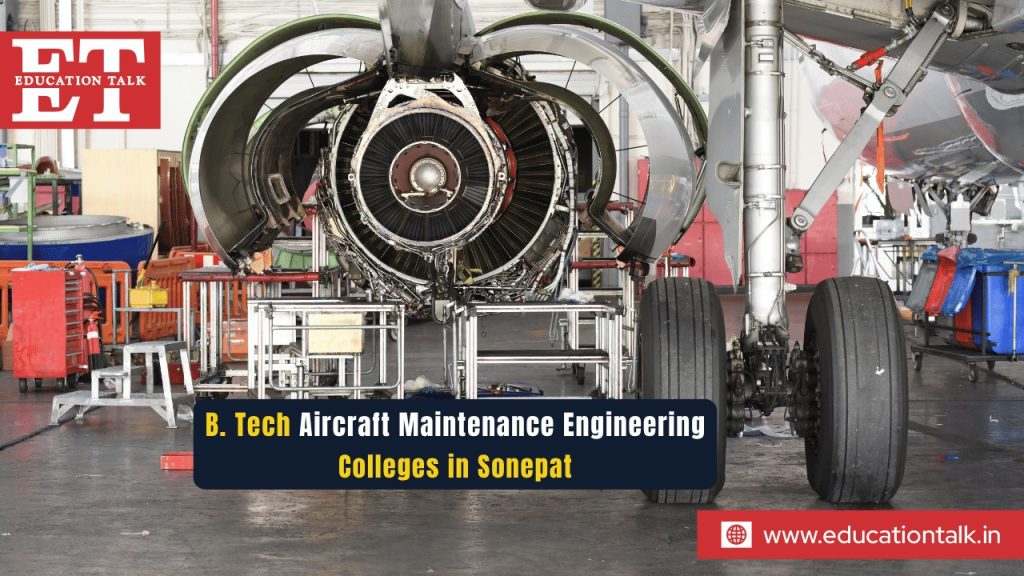
B Tech Aircraft Maintenance Engineering Colleges in Sonepat
Posted on : 9 October, 2026 11:47 pm
The aviation industry depends on more than pilots and cabin crew. Behind every flight is a team of trained professionals who inspect aircraft, maintain complex systems, identify technical faults, and help ensure that aircraft meet strict airworthiness requirements. For students interested in aircraft technology, mechanical systems, aviation safety, and engineering, this field offers an exciting opportunity to build a technical career.
If you are searching for B Tech Aircraft Maintenance Engineering colleges in Sonepat, it is important to understand the difference between aircraft maintenance engineering, aerospace engineering, and aeronautical engineering before choosing a college. Although these fields are closely related, they prepare students for different responsibilities and career pathways.
Located in Haryana, Sonipat is a convenient education destination for students exploring technical courses in the Delhi NCR region. Before applying, prospective students should verify the exact course title, current approval status, eligibility criteria, and available facilities.
This guide explains the courses available in this field, admission requirements, career opportunities, practical training considerations, and how to choose the right institution for your goals.
What Is Aircraft Maintenance Engineering?
Aircraft Maintenance Engineering (AME) is a specialised aviation discipline concerned with inspecting, maintaining, troubleshooting, and certifying aircraft for safe operation within the scope of an authorised licence. It involves aircraft structures, engines, electrical systems, avionics, maintenance procedures, technical documentation, and aviation safety regulations.
Aircraft maintenance professionals help ensure that aircraft remain airworthy and comply with applicable maintenance standards. Their work requires technical knowledge, attention to detail, practical skills, and a strong commitment to safety.
Unlike a conventional engineering degree, an Aircraft Maintenance Engineering licence follows a separate regulatory pathway. In India, students should check the Directorate General of Civil Aviation (DGCA) requirements before enrolling in an AME training programme.
What Does an Aircraft Maintenance Engineer Do?
Aircraft maintenance professionals may be involved in:
- Inspecting aircraft components and systems.
- Identifying mechanical, electrical, and electronic faults.
- Performing scheduled maintenance and repairs.
- Checking engines, landing gear, flight controls, and avionics.
- Reading technical manuals and maintenance records.
- Following aviation safety procedures and quality standards.
- Supporting compliance with aircraft airworthiness requirements.
The exact responsibilities depend on the individual’s training, qualifications, licence privileges, employer, and applicable aviation regulations.
B Tech Aircraft Maintenance Engineering vs Aeronautical Engineering vs Aerospace Engineering
One of the most important steps when researching aircraft maintenance engineering colleges in Sonepat is understanding which qualification matches your career goals.
Aircraft Maintenance Engineering focuses on aircraft maintenance and airworthiness, while aeronautical engineering focuses on aircraft design and related technologies, and aerospace engineering covers aircraft as well as systems designed for operation in space. These fields overlap technically, but their curricula, professional pathways, and licensing requirements differ.
| Course or pathway | Main focus | Potential career direction |
|---|---|---|
| Aircraft Maintenance Engineering (AME) | Aircraft inspection, maintenance, troubleshooting, and airworthiness | Licensed maintenance pathway, subject to regulatory requirements |
| B Tech Aeronautical Engineering | Aircraft design, aerodynamics, propulsion, and aircraft structures | Aircraft engineering, design, testing, research, and manufacturing |
| B Tech Aerospace Engineering | Aircraft, spacecraft, propulsion, flight systems, and related technologies | Aerospace design, simulation, research, testing, and development |
| B Tech Mechanical Engineering | Machines, materials, manufacturing, thermodynamics, and mechanical systems | Manufacturing, automotive, maintenance, energy, and related industries |
| B Tech Electronics or Avionics-related pathway | Electronic systems, instrumentation, communication, and control | Avionics-related engineering, electronics, testing, and systems integration |
Which Course Should You Choose?
Choose based on the work you want to perform after graduation.
- Choose an AME pathway if your primary interest is aircraft maintenance and you are prepared to meet the relevant licensing and practical experience requirements.
- Choose aeronautical engineering if you are interested in aircraft design, aerodynamics, structures, and propulsion.
- Choose aerospace engineering if you want broader exposure to aircraft, spacecraft, and advanced flight technologies.
- Choose mechanical engineering if you prefer a broader engineering degree that can support careers across several industries.
A degree in aeronautical or aerospace engineering does not automatically grant an AME licence. Similarly, completing an AME training programme does not automatically confer a B Tech degree.
Eligibility for Aircraft Maintenance Engineering and Related B Tech Courses
Eligibility depends on the exact programme, the awarding university, and the applicable aviation regulations. For a conventional B Tech engineering degree, applicants generally need a recognised Class 12 qualification with the required science and mathematics subjects, or an accepted diploma qualification for eligible lateral-entry routes. AME training and licensing may have additional requirements.
Students should verify the admission rules for the 2026–27 academic session before applying.
Academic Requirements After Class 12
The following checklist can help you prepare for an admissions discussion:
-
Educational qualification: Class 12 from a recognised board or another qualification accepted by the relevant programme.
-
Subjects: Physics and Mathematics are important for many engineering and aviation-related pathways. The precise subject combination depends on the course.
-
Minimum marks: Check the university’s current eligibility criteria and any applicable category-based relaxations.
-
Entrance examination: Ask whether admission is based on merit, an accepted entrance examination, or another permitted process.
-
Documents: Keep your Class 10 and 12 marksheets, identification, photographs, and any applicable category or transfer documents ready.
Do not assume that eligibility for a B Tech programme automatically establishes eligibility for an AME licence. The two requirements should be checked separately.
Course Duration, Subjects and Practical Training
A conventional B Tech programme generally takes four years to complete, subject to the programme structure and applicable academic rules. An AME training pathway has its own syllabus, examinations, practical requirements, and licensing milestones.
Important Subjects in Aircraft-Related Engineering
Students may encounter the following subjects, depending on their chosen programme:
|
Subject |
What students learn |
|---|---|
|
Engineering mathematics |
Mathematical methods used to solve engineering problems |
|
Engineering physics |
Principles of motion, energy, forces, and materials |
|
Aerodynamics |
How air flows around aircraft and affects flight |
|
Aircraft structures |
Loads, structural components, materials, and strength |
|
Propulsion |
Principles of aircraft engines and thrust |
|
Aircraft systems |
How mechanical and other onboard systems function |
|
Avionics and instrumentation |
Electronic systems, sensors, instruments, and monitoring |
|
Materials and manufacturing |
Material properties, component production, and engineering processes |
|
Maintenance practices |
Inspection, fault identification, technical records, and maintenance procedures, where included in the programme |
The actual syllabus varies. Applicants should request the current semester-wise curriculum instead of relying on a general subject list.
Why Practical Exposure Matters
Consider a student learning about aircraft propulsion. Classroom lessons can explain how an engine produces thrust, but practical demonstrations and supervised laboratory activities help the student connect those principles with components, instruments, and operating procedures.
Useful questions to ask during a campus visit include:
-
Which aircraft-related laboratories can students access?
-
Are practical sessions conducted regularly or mainly demonstrated by instructors?
-
Are aircraft, engines, or component training aids available for the selected programme?
-
Are industry visits, internships, or supervised projects included?
-
How are safety procedures and technical documentation taught?
These questions help students compare the actual learning experience rather than choosing a college solely because its programme name sounds specialised.
List of Aircraft Maintenance and Aviation Engineering Colleges
|
No. |
College name |
Location |
Type / relevant course |
|---|---|---|---|
|
1 |
Indian Institute of Technology Delhi (IIT Delhi) |
New Delhi |
Government institution; aerospace-related research and engineering, but not a dedicated AME college |
|
2 |
Puran Murti Vidyapeeth |
Sonipat |
Private; Aircraft Maintenance Engineering and aviation-related engineering programmes listed |
|
3 |
Deenbandhu Chhotu Ram University of Science and Technology (DCRUST) |
Murthal, Sonipat |
State university; engineering programmes, but verify current aviation-specific offerings |
|
4 |
Delhi Technological University (DTU) |
Delhi |
Government university; engineering programmes, not a dedicated AME college |
|
5 |
Netaji Subhas University of Technology (NSUT) |
New Delhi |
Government university; engineering programmes, not a dedicated AME college |
|
6 |
National Institute of Technology Delhi (NIT Delhi) |
Delhi |
Government institution; engineering programmes, not a dedicated AME college |
|
7 |
Indian Institute of Aeronautics |
New Delhi |
Aviation training; verify current DGCA approval and course availability |
Admission Process for Aviation Engineering in Sonepat
The admission process varies by institution and course. A sensible approach is to verify eligibility first, compare programmes, and confirm all fees and approvals before paying an admission amount.
How to Apply: Step-by-Step
-
Choose your career pathway. Decide whether you want a B Tech degree in aeronautical or aerospace engineering, a dedicated AME training pathway, or a combination of engineering education and AME training.
-
Check eligibility. Confirm your Class 12 subjects, marks, and any entrance examination requirements.
-
Verify recognition and approvals. Check the awarding university and the relevant programme approvals. For AME training, independently verify the training organisation’s applicable DGCA approval.
-
Request the official fee structure. Ask for tuition fees, registration charges, examination fees, hostel costs, and any additional training expenses.
-
Review facilities and practical training. Visit the campus and ask to see facilities relevant to your course.
-
Submit your application. Follow the institution’s official admission procedure and retain copies of receipts and submitted documents.
-
Confirm your enrolment in writing. Obtain documentation stating the programme name, awarding body, duration, fee schedule, and any separate licensing or training requirements.
Fees and Scholarships: What Should Students Expect?
There is no single fee applicable to all aircraft maintenance engineering colleges in Sonepat. Costs depend on the qualification, institution, training arrangements, and facilities included.
Rather than relying on an unverified online estimate, request a written, year-wise fee breakdown.
|
Expense |
What to confirm |
|---|---|
|
Tuition fees |
Annual fee and total programme cost |
|
Admission and registration |
One-time charges and refund conditions |
|
Laboratory and practical training |
Whether these costs are included in tuition |
|
Examinations |
University, examination, and any applicable licensing-related charges |
|
Hostel and transport |
Availability, fees, and payment schedule |
|
Additional training |
Costs for separate training, assessments, or specialist courses |
|
Scholarships |
Eligibility, required documents, renewal conditions, and deadlines |
How to Compare the Total Cost
Calculate the total expected expenditure for the entire programme, not just the first year’s tuition. Also ask whether scholarships reduce tuition only or cover other charges.
If a programme combines a B Tech degree with AME training, request clarification about whether both components are included in the advertised fee and whether they have separate admission, examination, or licensing requirements.
A transparent fee structure helps families plan responsibly and avoid unexpected costs later.
Career Scope After Aircraft Maintenance Engineering and Aviation-Related B Tech Courses
Career opportunities in aviation engineering extend beyond aircraft maintenance to include aircraft design, quality assurance, technical services, manufacturing, avionics, and research. The roles available to a graduate depend on their degree, practical experience, technical skills, employer requirements, and any mandatory licences or approvals.
India’s aviation sector provides a useful reason to explore this field. In February 2025, Boeing forecast that India’s and South Asia’s commercial aircraft fleet could grow nearly fourfold by 2043, with demand for 2,835 new aircraft over 20 years. This is an industry forecast, not a guarantee of employment, but it illustrates the scale of anticipated aviation expansion.
Career Options and Potential Employers
The following roles are illustrative. Eligibility and licensing requirements vary.
|
Career role |
Typical responsibilities |
|---|---|
|
Aircraft maintenance technician |
Inspection, servicing, and maintenance tasks within authorised responsibilities |
|
Licensed Aircraft Maintenance Engineer |
Maintenance certification and release-to-service responsibilities within applicable licence privileges |
|
Aeronautical design engineer |
Aircraft structures, aerodynamics, and design development |
|
Aerospace engineer |
Aircraft or spacecraft systems, simulation, analysis, and research |
|
Avionics engineer |
Aircraft electronics, instrumentation, and electrical or electronic systems |
|
Quality assurance engineer |
Quality checks, technical compliance, and documentation |
|
Aircraft manufacturing engineer |
Production processes, assembly, testing, and component quality |
|
Technical support engineer |
Troubleshooting, engineering documentation, and support for aviation systems |
Potential employment settings include airlines, maintenance, repair and overhaul (MRO) organisations, aircraft manufacturers, aerospace suppliers, aviation equipment companies, and engineering research organisations. Entry requirements differ across employers and positions.
Can You Become a Licensed Aircraft Maintenance Engineer After B Tech?
A B Tech degree alone does not automatically make someone a licensed Aircraft Maintenance Engineer in India.
Students who want to follow the licensed AME pathway should check the relevant requirements published by the Directorate General of Civil Aviation (DGCA). These can include approved training, applicable examinations, practical experience, and other conditions for the relevant licence category.
Before enrolling in a combined B Tech and AME programme, ask the institution to explain:
-
Which university awards the B Tech degree.
-
Which organisation delivers the AME training.
-
Whether the AME training organisation has the relevant current DGCA approval.
-
Which licence category or training pathway is offered.
-
What examinations, practical experience, and additional steps remain after graduation.
This distinction is particularly important for students who want to work in aircraft maintenance rather than aircraft design.
Salary After Aircraft Maintenance Engineering in India
Salary depends on the job role, employer, experience, location, qualifications, and licence status. A newly qualified engineering graduate may enter a different role and salary band from an experienced professional holding the required aviation licence.
Instead of relying on a single advertised salary figure, evaluate the following factors:
-
Entry-level qualification: The degree, diploma, or training pathway completed.
-
Licensing status: Whether the role requires a licence and whether the candidate holds it.
-
Practical experience: Exposure to relevant systems, equipment, and maintenance procedures.
-
Technical specialisation: Expertise in structures, propulsion, avionics, or other systems.
-
Employer and location: Airline, MRO, manufacturing, and other employers may offer different compensation structures.
Ask colleges for recent, verifiable placement information for the exact programme, including the number of eligible students, students placed, job titles, median salary where available, and recruiting organisations. The highest package alone is not a reliable measure of typical graduate outcomes.
Instead of relying on a single advertised salary figure, evaluate the following factors:
Entry-level qualification: The degree, diploma, or training pathway completed.
Licensing status: Whether the role requires a licence and whether the candidate holds it.
Practical experience: Exposure to relevant systems, equipment, and maintenance procedures.
Technical specialisation: Expertise in structures, propulsion, avionics, or other systems.
Employer and location: Airline, MRO, manufacturing, and other employers may offer different compensation structures.
Ask colleges for recent, verifiable placement information for the exact programme, including the number of eligible students, students placed, job titles, median salary where available, and recruiting organisations. The highest package alone is not a reliable measure of typical graduate outcomes.
How to Choose the Best Aircraft Maintenance Engineering College in Sonepat
The best college is the one that provides the right recognised qualification, relevant practical training, transparent costs, and a credible pathway towards your intended career.
Use this checklist when comparing colleges in Sonipat and Delhi NCR.
Conclusion: Start Your Aviation Engineering Journey in Sonepat
Choosing an aviation-related course is an important decision because it shapes your technical education, practical experience, and future career options. Before selecting among B Tech Aircraft Maintenance Engineering colleges in Sonepat, understand the difference between aircraft maintenance, aeronautical engineering, and aerospace engineering, and verify the qualifications and approvals associated with your preferred programme.
Ready to explore your aviation engineering options?
Speak with the admissions team, ask the right questions, and take an informed step towards your future in aviation.